
The Odyssey: An Epic, Roaring Masterpiece.
by Spencer Elkind
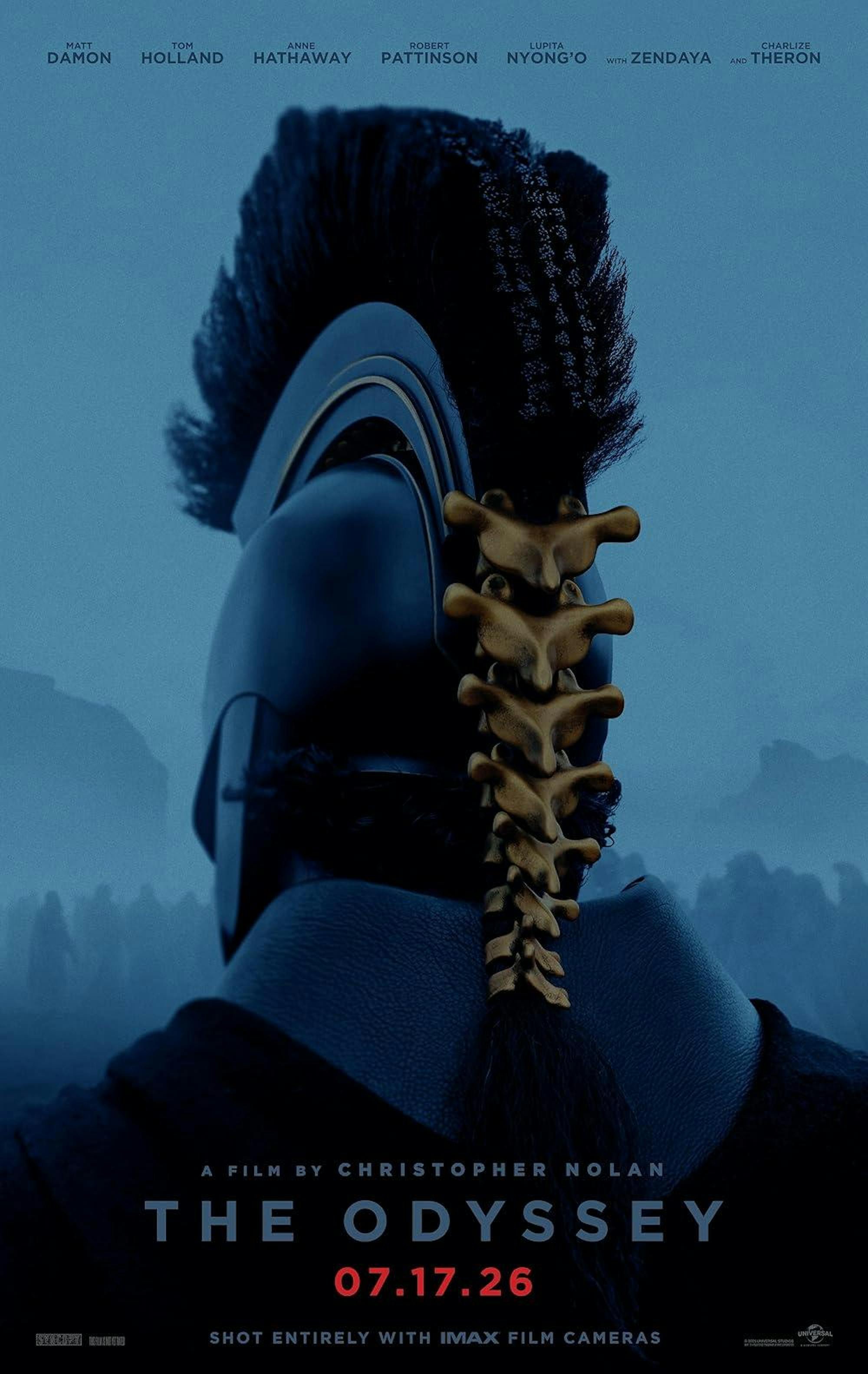
There is perhaps nothing I could say that will truly capture the impact of Homer’s Odyssey. Suffice to say, no story or piece of literature, film, or theater is independent of its influence. The tale of a man trying to get home to his family, using his wits and strength to outwit challenges, is the basis for the epic stories we love today. George Lucas, J.R.R. Tolkien, William Shakesphere, and every other storyteller ever can be traced back to Homer. The Odyssey isn’t just a story; it is The Story. And with the release of the new film, this three-thousand-year-old epic finally has a movie that truly lives up to its enormous legacy. Christopher Nolan’s The Odyssey is a masterpiece in every sense of the word, and a reminder of the endless potential of film.
Nolan, who could easily be considered one of the great directors of modern Hollywood, writes and directs this film based on the story we all remember from high school. In a time of magic and monsters, Odysseus (Matt Damon) is attempting to return to his home of Ithaca after leading the sacking of Troy. Meanwhile, a horde of suitors occupies his home on Ithaca, seeking to marry his wife Penelope (Anne Hathaway), even though she and his now adult son Telemachus(Tom Holland) still believe Odysseus will return one day.
Starting with my favorite aspect of the film, it can’t be anything but the scale. The Odyssey made film history for being the first feature shot entirely with IMAX cameras. I was lucky enough to see it on a 70mm IMAX screen as well, of which there are only a few dozen in the world. These factors combined created perhaps the most immersive cinema experience I’ve ever had. Nolan takes the world of Greek mythology and not only brings it to life, but makes it feel truly real. We feel the scale of the Cyclops, the force of the waves crashing against the ships, and the air of fear as the dead rise from the Underworld. The practical effects of these scenes are unreal, and even the CGI feels like it’s practically not there. The scene where Circe slowly shifts and molds Odysseus’s men into pigs is genuinely horrifying, feeling less like CGI and more like actual, genuine sorcery. This feels at every turn like a living, breathing world that we are a part of. A lot of that can also be credited to a fantastic score by Ludwig Göransson, which perfectly balances tension and moments of calm, especially during the final battle in the halls of Ithaca; (Although I think the score can sometimes get a little too loud, making it harder to hear the dialogue).
The cast was overall excellent. Matt Damon brings a much more vulnerable side to Odysseus than I had expected, and I was surprised at how little Tom Holland as Telemachus took me out of the movie. The most impressive performances for me however were some of the supporting characters. John Leguizamo is incredible as the blind shepherd Eumaeus, and I wouldn’t be shocked to see him get an Oscar nomination. Samantha Morton is quietly terrifying as Circe, and Elliot Page’s Sinon makes a considerable impact in his relatively few scenes.
That being said, the one major issue I had with the movie overall was that Nolan might have overcast a lot of the roles. There are so many stars and great actors that inevitably, a lot of people are going to be left on the sidelines. Casting Lupita Nyong’o as both Helen of Troy and Clytemnestra was an interesting idea, but she only has like one scene of each, so it hardly matters. Benny Safdie as Agamemnon has a great presence, but we never even see his face. And finally, Zendaya’s Athena is appropriately ethereal, but for an actor of her caliber, I was surprised to see Athena’s role significantly shaved down from the original epic.
Which brings me to an element of the film that I’m sure will be controversial: the lessened role of the gods. Now the movie never questions if the gods are real, as even the idea of Athena being some kind of hallucination is ditched by the back third of the film. But other than her, no other gods appear in physical form. From Athena’s first scene, it’s clear that Nolan is trying to depict the gods as people in Ancient Greece would have seen them, not as big bearded men in togas. The Olympians served as ways for people to reckon with parts of theworld that they didn’t understand, and even though they are real within the contents of this movie, that continues to be their purpose. It almost feels like, after the Trojan War, most of the gods are withdrawing from the world at large, with Athena staying just long enough to guide her most treasured soldier home. When she disappears after her final scene with Odysseus, it feels like that might be the last time for centuries a human encounters an Olympian.
And that’s the final aspect of this movie I want to touch on: the ending. Nolan goes especially deep into an idea that I didn’t expect this movie to touch on at all, and that is the Odyssey serving as a conclusion to the Greek mythos. The Trojan War and the journeys home are the final Greek myths as the period of gods and monsters comes to an end. This movie is about how the virtues of men are being lost, giving way to brutality and horrors, and Odysseus’s role in kicking off this new era. In a time where we feel more divided than ever, Nolan has somehow made our oldest story incredibly relevant once again. The mentions of “raiders from the sea” aren’t a rehashing of old Eurocentric history, but a reminder that we no longer see our enemies as humans anymore. And in a world like this, what can we do? Well, similar to Odysseus, we can defy fate and defy the gods to fight for what we love. All in all, Christopher Nolan’s The Odyssey is by far the best movie I have seen all year, and I doubt that it will be topped. I would encourage anyone who loves this story, or simply loves the power of cinema, to see this movie on the biggest screen you can find. If you do, I promise you will never forget the experience.